How many Cheshire homes this is
The 2021 census counted 7,441 Cheshire East households heated by oil alone, 4.3% of the total, and 5,505 in Cheshire West and Chester, 3.5%. Warrington had 417. Across England and Wales the oil share was 3.5%. Add the homes on tank or bottled gas and 19,096 households across the three areas relied on oil or LPG alone. Most are rural: farmhouses, cottages and villages beyond the reach of the gas main.
What the swap involves
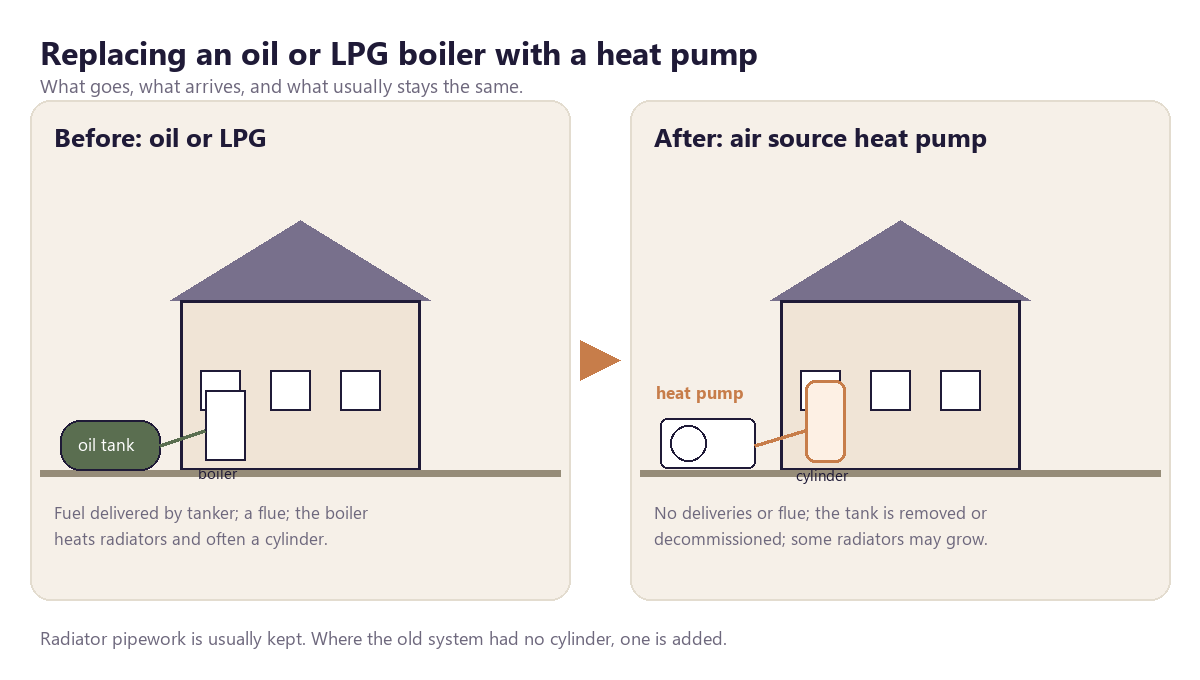
- A design. A room-by-room heat-loss calculation sizes the heat pump and shows which radiators, if any, need to be larger.
- The outdoor unit or ground loop. An air source unit needs a spot outside with air flow; a ground source system needs trenches or a borehole.
- A hot water cylinder, if the home does not already have one suited to a heat pump.
- Radiator changes where the design calls for them. The pipework usually stays.
- The old system. The boiler and flue come out; the oil tank or LPG tank is emptied and removed or decommissioned, and an LPG tank owned by the supplier is usually collected by them.
Ending an LPG supply usually means giving notice under the supply contract, so check its terms before the installation date. With oil, time the last delivery so the tank is close to empty when the boiler is switched off.
The higher grant band: the conditions in full
The Boiler Upgrade Scheme normally pays £7,500 towards an air source or ground source heat pump. GOV.UK describes an additional £1,500 until March 2027 for homes moving off oil or LPG, and Ofgem sets out the higher band of £9,000. All of these must be true:
- The heat pump is an air source or ground source heat pump. Hybrids and biomass do not get the higher band.
- The property is currently heated by oil or LPG.
- The property has no mains gas connection. Ofgem's guidance defines an off-gas-grid property as one not fuelled by mains gas, with no record of an existing gas meter point, not attached to a heat network, and not a new build. A capped or clamped gas meter still counts as mains gas.
- The application is properly made by the installer between 21 July 2026 and 31 March 2027.
- The usual scheme rules are met: the owner owns the property, it is not social housing, and the installer is certified and belongs to a consumer code.
The window matters. Ofgem says the higher band is for applications properly made in that period, so the installer's application date is what counts, not the date you first ask for a quote.
Running costs: compare units of heat
Comparing an oil bill with an electricity bill misleads, because the systems turn fuel into heat at very different rates. Work out the price of a unit of heat for each: your oil price per kWh divided by the boiler's efficiency, and your electricity price per kWh divided by the heat pump's seasonal efficiency. Oil is sold by the litre, so convert using the energy content your supplier quotes. The answer depends on oil prices at the time and the heat pump's real efficiency, which the design should state.
Questions to ask before you sign
- Does the quote include removing or decommissioning the tank, and disposing of any oil left?
- Which radiators change, and what flow temperature is the system designed for?
- Where does the cylinder go, and how big is it?
- When will the grant application be made, and does it fall inside the higher-band window?
The rural route finder shows which routes and grant bands fit your answers, and the ground source page covers the option for homes with land.
Living with the change
The day-to-day difference is bigger than the hardware. There is no tank to watch, no delivery to book and no risk of running out over a holiday weekend. The heat pump runs steadily at a low temperature rather than firing in bursts, so radiators feel warm rather than hot while rooms stay at the set temperature. It needs an annual service, like the boiler did, but no flue checks or fuel filters.
If the oil boiler is fairly new, the decision is less obvious: replacing a working boiler early costs more than replacing one at the end of its life. The higher grant window to 31 March 2027 shifts that calculation for some households, which is why the timing of the installer's application matters. A home that keeps an oil boiler as a backup with a heat pump is a hybrid, and hybrids get no Boiler Upgrade Scheme grant.
The consortium grant is the other route for lower-income households.
For a farmhouse or rural home with land, ground source in Cheshire explains the trench and borehole options; lower-income households in poorly rated homes should read the consortium's Warm Homes: Local Grant first; and the rural route finder turns your answers into one set of routes.